

The Bill That Surprises New Owners
Most buyers walk into a commercial equipment purchase focused on two things: upfront price and rack capacity. Water consumption? That usually gets a glance at the spec sheet - if it gets looked at at all.
Then the first utility bill arrives.
A busy restaurant running 80 to 100 racks per day can easily spend $200 to $400 annually on dishwasher water alone, depending on the machine they chose and the local utility rate. The frustrating part is that this number is entirely predictable before purchase - it just requires knowing which figures to pull and how to combine them.
This guide covers exactly that. Not a general overview of commercial dishwashers, but the specific calculation process for understanding what a hood-type dishwasher will cost to run in water, month by month, before you commit to buying one.
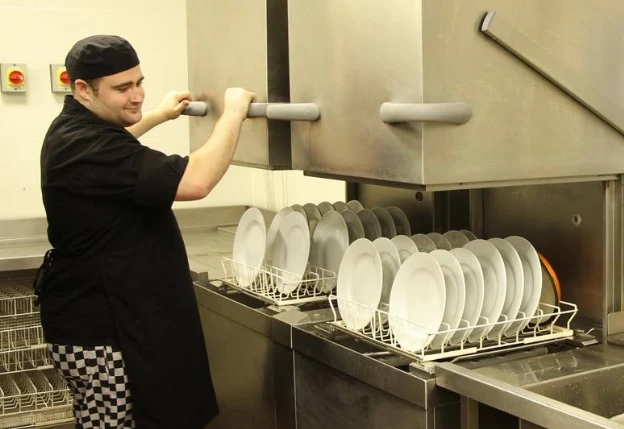
Hood-Type Dishwasher Water Consumption
Why Hood-Type Machines Have a Different Water Logic
It's worth understanding the mechanics briefly, because they explain why the numbers work the way they do.
A hood-type dishwasher doesn't drain and refill after every cycle the way a home appliance does. The wash water sits in a tank, gets recirculated through rotating spray arms, and keeps working across multiple racks. Fresh water only enters the system during the final rinse - a high-temperature flush that lasts roughly 8 to 12 seconds and sanitizes the load before the hood lifts.
That rinse water then drains into the wash tank, where it tops up the recirculating supply for the next cycle. The whole process - wash, rinse, done - runs in 60 to 120 seconds.
This is why the relevant number isn't "water per cycle" in the residential sense. The figure that actually matters for budgeting is gallons per rack (GPR): how much fresh water the machine consumes to process one loaded rack of dishes, cutlery, and glassware. Every manufacturer's technical spec sheet lists this. If yours only shows liters, divide by 3.785.
Typical GPR ranges across the hood-type category:
- Entry-level machines: 1.0 to 1.5 GPR
- Mid-range machines: 0.6 to 1.0 GPR
- High-efficiency / Energy Star certified: 0.4 to 0.65 GPR
The U.S. EPA has confirmed that high-efficiency commercial dishwashers can cut water use by up to 40% versus older standard models. In a kitchen running 300 days a year, the difference between a 1.4 GPR machine and a 0.7 GPR machine at the same daily volume is roughly 12,000 gallons annually - not a rounding error.
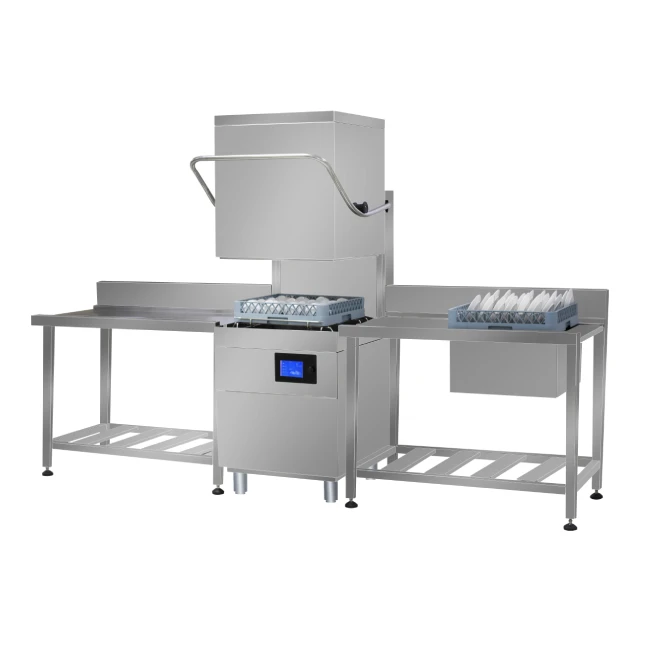
OUGER Small-scale Catering Dishwasher
The Calculation, Step by Step
This is the framework commercial kitchen consultants use when evaluating equipment before procurement. It's straightforward once you have the right inputs.
Step 1: Pull the GPR from the spec sheet
Don't rely on brochure language like "water-saving" or "eco-mode." Find the technical data table and locate gallons per rack or liters per rack under verified test conditions. Machines with NSF/ANSI 3 certification have had this figure independently validated, which matters when you're comparing across brands.
Step 2: Estimate your daily rack volume
A working rule across the foodservice industry: every 100 covers (meals served) generates roughly 35 racks of warewashing. A restaurant serving 150 covers across lunch and dinner would produce around 52 to 55 racks per day. Adjust upward if your menu involves heavy cookware or multiple smallwares - these tend to run inefficiently loaded and inflate your real rack count.
Step 3: Calculate annual water consumption
The EPA WaterSense formula for stationary rack-type commercial dishwashers:
- Annual Water Use = GPR × Daily Racks × Operating Days Per Year
- Step 4: Convert to monthly cost
- Monthly Water Cost = (Annual Water Use ÷ 12) ÷ 1,000 × Local Water + Sewer Rate
Combined water and sewer rates in U.S. cities typically run $8 to $15 per 1,000 gallons. Coastal California and parts of the Southwest push $18 to $22. Check your current utility bill for the combined rate - it's usually listed per CCF (hundred cubic feet) or per 1,000 gallons.
A concrete example:
A 70-seat neighborhood restaurant, two services daily, 150 average covers:
- Daily racks: approximately 52
- Operating days: 300
- Machine GPR: 0.85 (mid-range unit)
- Local water + sewer rate: $12 per 1,000 gallons
- Annual water use: 0.85 × 52 × 300 = 13,260 gallons
- Monthly average: 1,105 gallons
- Monthly water cost: $13.26
- Annual water cost: $159
- Now swap in an entry-level machine at 1.4 GPR, same restaurant:
- Annual water use: 1.4 × 52 × 300 = 21,840 gallons
- Annual water cost: $262
The gap is $103 per year - before counting the additional energy cost of heating 8,580 extra gallons of rinse water, which typically adds another $60 to $120 annually depending on your water heater fuel type and incoming water temperature.
Over a machine's 10-year service life, that efficiency gap compounds into a real number.
Water Cost in Context: The Full Monthly Operating Picture
Water is one line item. Buyers who focus on it in isolation sometimes make false economies elsewhere. The complete monthly operating cost for a hood-type machine covers four areas:
Energy runs higher than most buyers expect, and not always where they expect it. The active wash cycles consume power - typically 10 to 15 kW during operation - but total daily active time might only be 30 to 50 minutes. What catches operators off guard is idle energy: keeping the wash tank at operating temperature between services. A well-insulated machine with an effective standby mode can cut idle consumption significantly. Ask the manufacturer for the idle energy rate (measured in kW), not just the operating wattage.
Chemicals - detergent and rinse aid - typically cost $0.08 to $0.18 per rack depending on product and water hardness. High-temperature machines sanitize via heat (the rinse water reaches above 180°F / 82°C), which generally reduces chemical spend. Low-temperature machines rely on chemical sanitizer added to the rinse, which adds a recurring per-rack cost but avoids the energy load of sustained high-temperature operation.
Maintenance is worth budgeting at 1% to 2% of purchase price annually for a realistic estimate. Descaling, spray arm replacement, door gasket wear, and periodic service visits are the main recurring items. In hard water areas - anything above 120 mg/L, or roughly 7 grains per gallon - an integrated water softener prevents scale accumulation on heating elements and spray nozzles. Without one, hard water quietly shortens component life and degrades wash performance over time.
Knowing When a Different Machine Type Makes More Sense
The hood-type category is well-matched to kitchens serving roughly 60 to 200 covers per sitting. Outside that range, it's worth running the same calculation on alternatives before deciding.
A rack conveyor dishwasher moves racks through automatically on a continuous belt, handling 150 to 250 racks per hour versus the 40 to 100 typical of a hood-type unit. For operations regularly pushing 250-plus covers per service, the throughput difference justifies the higher footprint and absolute water consumption. For a 90-seat restaurant running moderate volume, it's usually oversized - and the operating costs reflect that.
At lower volumes, a conveyor-type dishwasher - a compact pass-through design that handles moderate throughput with a smaller footprint than a full rack conveyor - can be a practical middle ground. GPR varies more widely in this category than in the hood-type segment, so spec-sheet comparison is especially important here.
For most independent restaurants, mid-sized hotels, and institutional kitchens, the hood-type remains the most operationally and financially sensible choice. The calculation above is how you confirm that - or find out if a different type fits better before purchase, not after.

OUGER S250 Rack Conveyor Dishwasher
What to Do Before You Buy
Pull the technical spec sheets for the two or three machines you're seriously considering. Find the GPR for each. Run the annual water use formula with your estimated daily rack volume. Add energy, chemical, and maintenance estimates to build out a full monthly operating cost for each option. Then compare that total against purchase price.
A machine priced $1,500 higher that saves $280 per year in water and energy pays back the premium in a little over five years - and keeps saving for the rest of its service life. That math is available to any buyer who asks for a spec sheet and spends 15 minutes on the calculation. Most don't, which is why so many operators end up anchored to a purchase price that looked attractive and an operating cost they didn't see coming.
FAQ
Q1: What GPR should I be targeting for a new hood-type purchase?
For a new machine bought today, 0.65 GPR or below is a reasonable target. Energy Star-certified units at this level or better are independently verified - the current Energy Star product list includes confirmed GPR figures you can plug directly into the calculation above. Anything above 1.2 GPR in a new unit represents an efficiency gap that deserves a clear cost justification before you accept it.
Q2: Does water hardness change how much water the machine actually uses?
Hard water doesn't change GPR on a spec sheet, but it changes real-world consumption over time. Scale accumulates on spray nozzles and restricts flow distribution, which means more racks come out needing a second pass. That second pass doubles the water cost for those loads. An inline softener prevents this and is worth serious consideration in any area with hardness consistently above 120 mg/L.
Q3: High-temperature or low-temperature machine - which uses less water?
High-temperature machines generally consume less water per cycle. They sanitize with a brief burst of very hot water (180°F / 82°C at the rack surface), which handles both rinsing and sanitization in one stage. Low-temperature machines require a separate chemical sanitizer rinse that adds volume. In a high-volume kitchen, this difference adds up across thousands of cycles per year. The tradeoff is higher electricity consumption on the high-temp side to maintain rinse water temperature.
Q4: My current machine seems to be using more water than the spec suggests. What's usually causing that?
Three things account for most of the gap between rated and actual consumption. First, clogged or worn spray nozzles that force staff to re-run racks. Second, a rinse solenoid valve that's out of calibration and over-delivering water on each cycle - a technician can check and reset this quickly. Third, consistently underloaded racks: a half-loaded rack uses the same water as a full one, so effective loading training can reduce your real GPR significantly without touching the machine at all.
Q5: My utility bills in cubic meters. How do I adapt the formula?
Multiply the machine's consumption in liters per rack by your daily rack count and annual operating days. Divide the result by 1,000 to get cubic meters. Apply your combined water and wastewater rate per cubic meter. As a reference point, UK combined rates average around £3.50 per cubic meter. A machine consuming 3.2 liters per rack, running 50 racks daily for 300 days, uses 48 cubic meters per year - roughly £168 at that rate. The same formula structure applies regardless of the unit system.


