

OUGER Dishwasher Drying Module: Infrared Design, Customization and Testing
A commercial dishwasher drying module should be evaluated against a practical requirement: can the washed tableware move into the next handling stage without creating a drying bottleneck?
In a busy canteen, wet trays may occupy unloading space while staff wait to stack them. In a central kitchen, residual water can interrupt sorting or packing. Adding a drying section can address these needs, but its suitability depends on the tableware, conveyor speed, available space and agreed drying result.
OUGER, the commercial dishwasher brand of Zhejiang Zhongyi Ouge Electrical Appliance Co., Ltd., has a published Chinese patent application describing an infrared tableware drying design. This article explains its main components and shows how buyers can connect a technical design with a specific equipment proposal, customization review and acceptance test.

What OUGER's Published Drying Design Describes
Its principal components include a housing, infrared emitters, a tableware conveyor, and upper and lower reflecting plates.
Infrared radiation transfers heat to surfaces that absorb it. In plain language, the emitters supply radiant heat, while the reflecting plates help redirect that radiation within the drying enclosure.
The application describes using the upper and lower reflecting structures to improve the use of the emitted radiation. Its stated design objectives include improving drying efficiency and reducing the number of emitters required.
These objectives explain the engineering intention. They do not establish a measured electricity saving, a guaranteed drying time or a result for every type of tableware.
Buyers reviewing OUGER certificates and patent documentation should also confirm which documents relate to the proposed equipment. The published application describes a particular design; its latest legal status and its application to a current model require separate verification.

Internal drying arrangement shown in Chinese patent application publication CN113670060A, Figure 2
How the Components Relate to Drying Performance
Infrared Emitters: Supplying Heat
Infrared emitters provide the radiant energy used in the described drying arrangement. However, installed heating capacity alone does not explain the final result.
The tableware's material, shape and position affect its exposure to heat. A shallow plate and a deep bowl can present different surfaces to the emitters, even when they pass through the same enclosure.
For procurement, the useful question is whether the proposed arrangement can treat the intended items at the required production rate.
Reflecting Plates: Redirecting Radiation
The reflecting plates are an important feature of the published design. Their purpose is to redirect radiation within the enclosure, supporting the use of energy supplied by the emitters.
This provides a concrete subject for a technical discussion. Buyers can ask the manufacturer to explain the proposed reflector arrangement and identify it in a drawing or equipment photograph.
The presence of reflecting plates should not be treated as proof that every surface receives identical exposure. Loading patterns and tableware geometry still need to be considered during testing.
Conveyor: Controlling Exposure Time
The conveyor carries tableware through the drying area. Its speed affects dwell time, meaning the time an item spends inside the active drying zone.
For a straight section operating at a constant speed:
Dwell time = active drying length ÷ conveyor speed.
For example, a hypothetical 1.2-metre active section operating at 2 metres per minute provides approximately 36 seconds of travel time. This is an illustration of the relationship, not an OUGER equipment specification.
A proposal should therefore identify the drying length and operating speed together. Quoting one without the other gives an incomplete picture of the process.
Comparing Infrared and Hot-Air Drying Proposals
Commercial drying equipment can use different ways of supplying heat and moving moisture away from tableware.
A hot-air arrangement directs heated air over the items. An infrared arrangement supplies radiant heat to exposed surfaces. Some systems may combine heating methods, but the configuration must be confirmed for the machine being quoted.
Buyers should compare the proposed systems using the same tableware, loading pattern, throughput and drying requirement. A technology name alone cannot determine which proposal best suits an installation.
For example, a school canteen handling reusable trays may need a different test from a hotel handling ceramic plates and bowls. The operating conditions should reflect the buyer's actual workload.
Ask each supplier to explain the heating method, moisture removal arrangements and operating controls included in its quotation. This makes the technical comparison more useful than comparing claims such as "advanced drying" or "high efficiency."
What a Customized Drying Proposal Should Address
A custom dishwasher drying system starts with a clear description of the operation. Customization should be expressed through an agreed specification, rather than a general promise that every feature can be changed.
Tableware and Loading
Provide the material, dimensions and photographs of representative items. Identify recessed bases, deep compartments and other locations where water remains after washing.
Also show how the items will travel through the machine. Upright plates, closely packed bowls and horizontal trays create different exposure and drainage conditions.
The manufacturer should assess the complete loading arrangement before recommending a drying configuration.
Production Requirements
Specify the required output during the busiest operating period. Average daily volume alone may hide a short period of much higher demand.
Where several types of tableware share the line, state their approximate proportions. A proposal tested only with easy-to-dry items may not represent the full workload.
Buyers considering rack conveyor dishwashers with drying sections should ask which operating speed and loading assumptions support the quoted capacity.
Layout and Connections
Supply a dimensioned layout showing the available space, conveyor direction, unloading area and maintenance access.
The review should also cover the connection between washing and drying stages, including transfer height, conveyor arrangement and controls.
An additional drying section affects the line layout. Its suitability should be checked against the existing equipment and site conditions before an installation plan is approved.
Utilities and Maintenance
Confirm the available electrical supply and ask the supplier to list the proposed connected load. Any ventilation or exhaust requirements should also appear in the installation documentation.
Maintenance access deserves the same attention as production capacity. Ask how operators can inspect and clean accessible internal surfaces, and how service personnel reach components requiring replacement.
OUGER's manufacturing operation includes research and development, production and customized solution services. Information about OUGER manufacturing and engineering capabilities provides company background; the quotation and approved drawings should define the scope of each project.
How to Test a Commercial Dishwasher Drying Module
A useful acceptance test makes the expected result visible and repeatable. It should use representative tableware under agreed operating conditions.
The following checklist is a starting point for a project-specific test, rather than a published performance guarantee.
|
Test item |
What to agree before testing |
|
Tableware |
Materials, dimensions, quantities and representative difficult items |
|
Loading |
Orientation, spacing and conveyor coverage |
|
Operating conditions |
Conveyor speed, selected settings and upstream wash/rinse conditions |
|
Observation point |
At the outlet or after an agreed waiting period |
|
Dryness requirement |
Defined locations and the permitted presence of droplets or pooled water |
|
Temperature |
Any handling or material limits that must be checked |
|
Energy measurement |
Measurement boundary, test duration and output during the test |
Define the Required Result
"Dry" needs a practical definition.
One operation may require no visible droplets on the main eating surface after an agreed interval. Another may focus on water trapped in tray compartments before sorting. These are different acceptance conditions.
Agree on the observation method and record the locations being checked. A photograph or video should show those locations clearly.
Test at the Required Output
A demonstration should use the proposed working speed and loading pattern. It should also run long enough to assess performance during continuous operation.
Record the speed and settings alongside the result. Without that information, a dry sample cannot show whether the same result is achievable at the required throughput.
Keep the Evidence Together
A useful test record combines the equipment configuration, operating conditions, photographs or video, and measured results.
Where adjustments are made during testing, document the final settings and repeat the relevant checks. This gives the buyer and manufacturer a common reference for commissioning and operator guidance.
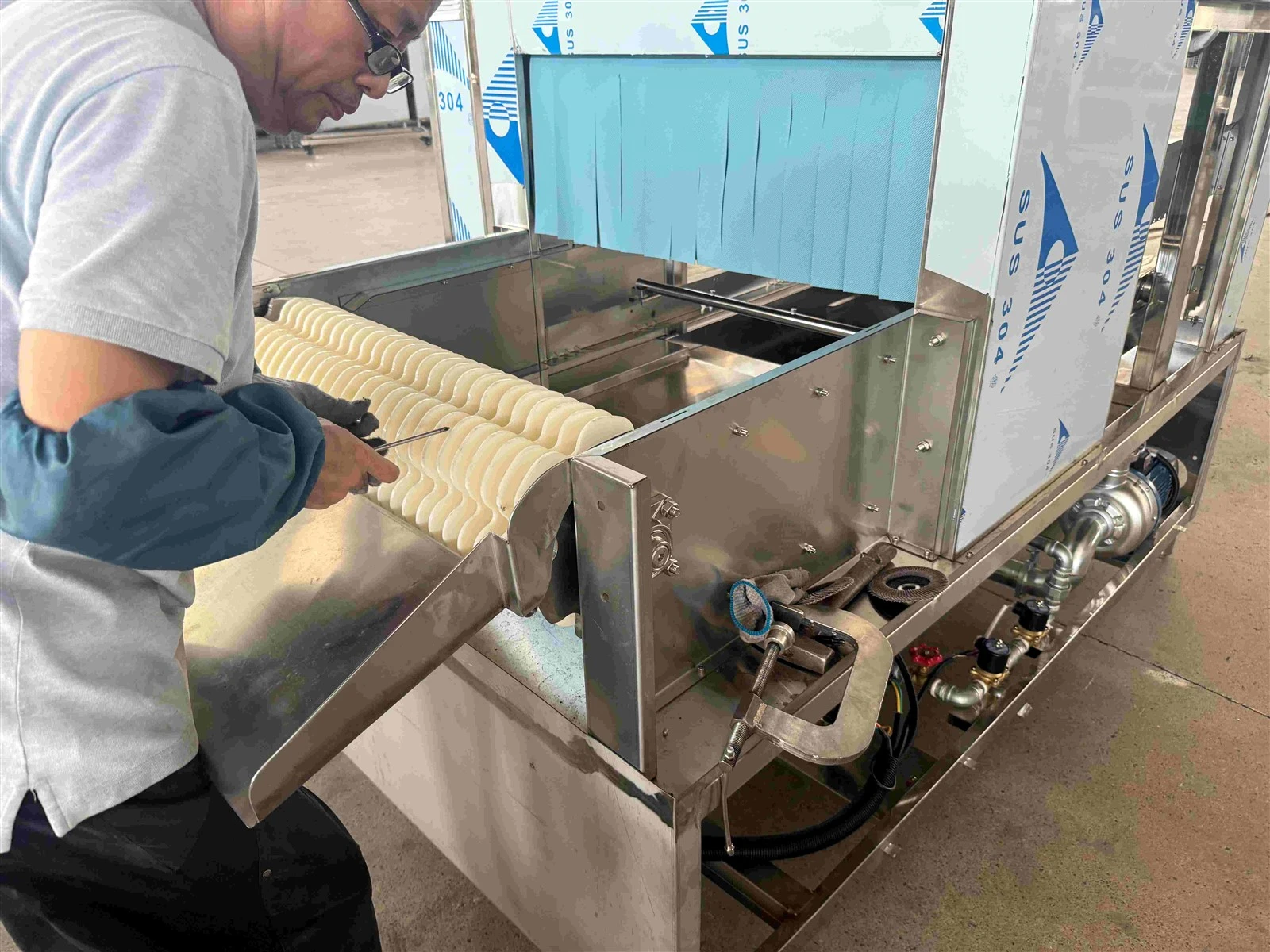

Drying performance should be assessed using representative tableware at an agreed conveyor speed and observation time
Compare Running Costs Under Equivalent Conditions
Connected power and actual energy consumption describe different things.
Connected power, expressed in kilowatts, identifies the electrical load used for installation planning. Energy consumption, expressed in kilowatt-hours, measures electricity used over time.
A fair cost comparison requires both proposals to meet the same output and drying requirement. It should identify whether the measurement covers only the drying module or the complete dishwasher.
Where measured energy is available:
Electricity cost per 1,000 items = measured kWh ÷ processed items × 1,000 × electricity tariff.
Warm-up and idle operation should be identified separately or included consistently.
For a broader investment discussion, buyers can review S250-D drying section investment considerations. The technical evaluation should still establish whether the quoted configuration meets the intended task before any payback calculation is accepted.
Turn the Technical Discussion into a Clear Specification
OUGER's published infrared drying design offers a specific structure to examine: emitters, reflecting plates and a conveyor working within an enclosure.
The next step is to connect that structure with the equipment being proposed. Confirm the applicable model, included components, operating conditions and acceptance criteria.
To begin a project review, prepare representative tableware details, peak throughput, a layout drawing and the available utilities. Ask for a documented configuration and an appropriate test plan.
You can discuss your dishwasher drying requirements with OUGER to establish the information needed for a quotation and technical assessment.
FAQ
Can this drying design be added to an existing dishwasher?
Compatibility requires an engineering review. Conveyor height, transfer arrangements, controls, electrical capacity and available space must be checked. The existence of a separate drying design does not establish compatibility with every installed dishwasher.
Does infrared drying remove the need for rinse aid?
That should not be assumed. Chemical use and dosing depend on the complete wash-and-rinse process, water conditions and the equipment instructions. Ask the manufacturer to confirm the required operating procedure for the proposed installation.
What happens if we introduce different tableware later?
A change in material, dimensions or loading pattern may require another assessment. Keep the original test conditions and results, then use representative new items to confirm whether settings or equipment changes are needed.
Which replacement-part information should be requested?
Request the applicable parts list, component identification, replacement procedures and recommended spares. Confirm supply arrangements and service responsibilities as part of the equipment order.
Does drying also prove that tableware has been disinfected?
A dry surface does not demonstrate that a required disinfection result has been achieved. Hygiene performance must be supported by applicable process conditions and verification. Drying performance and hygiene claims should be documented separately.


